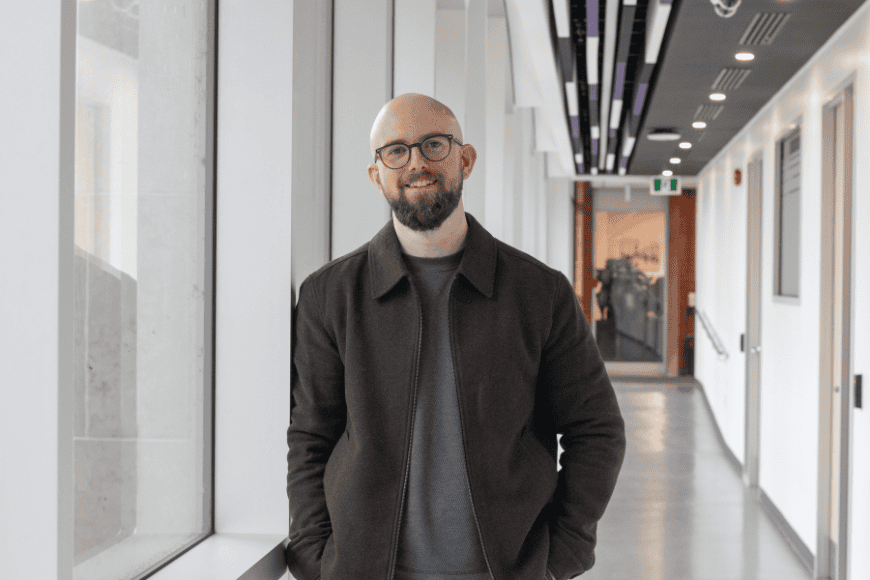
Graduate Student Zach Fry: Death Anxiety and Clinical Preparedness:- Exploring How Clinical Psychology Trainees Experience and Navigate Conversations About Death
Zach Fry’s path to Bishop’s University is an unusual one. At 18, like many people at that age, he was unsure of what he wanted to do with his life. He enrolled in the General Arts and Science: University Profile program at Sheridan College in Oakville, Ontario, where he spent two years exploring different fields while preparing for future academic studies. He had a general interest in the social sciences and humanities but wasn’t yet certain about a specific direction. Within two months of starting the program, however, he realized that becoming a psychologist was what he wanted to pursue.
During his second year, while preparing university applications, Zach recalls a class discussion with a respected professor about where to apply. The professor asked what the best university in Canada was, prompting answers like the University of Toronto, McGill, and UBC. He rejected each one before confidently stating Bishop’s University—a school none of the students had heard of. That same evening, Zach looked into it and found that it offered everything he didn’t know he needed: small classes, close relationships with professors, and a strong sense of community.
Without ever visiting the campus, he applied to Bishop’s for psychology and was accepted. Looking back, it was a risky decision—moving eight hours away from home to a place where he didn’t know anyone—but it proved to be the best decision he ever made. Everything he had read about Bishop’s turned out to be true. He felt a strong inner pull to go, and following it ultimately shaped his academic and professional trajectory. Today, he credits that decision, and the people he met along the way, for playing a major role in his development as a PhD student.
Zach is currently enrolled in the experimental psychology PhD program at the University of Wollongong in Australia. His path there is directly tied to his time at Bishop’s, particularly during his individualized master’s program. During that period, his supervisor introduced him to an opportunity to complete a research internship at Wollongong under the supervision of Professor Vida Bliokas. During the three-month internship, he worked on multiple research projects, including one evaluating a peer-based suicide aftercare program. Another project developed into what is now his PhD thesis.
His thesis focuses on how clinical psychology students think and feel about death. Early findings suggest that, like most people, they may experience death anxiety. If so, this could present a barrier in clinical settings, where therapists may feel unprepared to engage in conversations about death with their clients. Since these topics are often central to therapy, understanding whether clinicians are equipped to navigate them is essential.
After completing his BA, Zach worked in a nursing home providing psychosocial support to residents. He worked closely with individuals who were terminally ill or living with conditions such as depression, anxiety, schizophrenia, and bipolar disorder. The work was both deeply fulfilling and emotionally demanding. He formed meaningful relationships with residents, many of whom passed away not long after. He remains grateful that many chose to spend part of their final days with him.
At times, however, he felt out of his depth and questioned whether he had the training needed to properly support the individuals he worked with. Seeking guidance, he reached out to Dr. Catherine Malboeuf-Hurtubise, a professor he had worked with during his undergraduate studies. During that conversation, she offered to take him on as a master’s student in Bishop’s individualized program. That experience became one of the most enriching periods of his life. Together, they worked on numerous projects, and Zach had the opportunity to travel internationally for research and conferences, including to Australia, England, Scotland, Ireland, and several cities in the United States. These experiences contributed significantly to both his professional and personal growth.
His interest in studying death began during his time in the nursing home. He noticed how an awareness of mortality often led to a deeper appreciation of life. Individuals with limited time seemed more present, more intentional, and more attentive to their surroundings and relationships. This contrasted with how easily time can be taken for granted in everyday life. These observations led him to reflect on how people find meaning despite life’s inherent limitations.
Later, while working in Dr. Malboeuf-Hurtubise’s child psychology lab, Zach began to wonder whether children also engage with these kinds of questions. This curiosity aligned with her own research interests, particularly the idea that children need opportunities to explore difficult topics, even though adults often feel uncomfortable initiating those conversations. His master’s research focused on how children engage with themes such as death, identity, and emotion, and how creative arts combined with philosophical dialogue can support them.
During one workshop, a child asked, “what is the point of it all if we are just going to die anyway?” That moment, along with patterns observed in the data, highlighted that children, like adults, are capable of engaging in existential thinking. Since then, this has remained a central focus of his research.
While research on how children understand death already exists, whether they engage in existential reflection is less explored. Much of the philosophical literature on existentialism has historically overlooked childhood, and therapeutic approaches based on these ideas have rarely been adapted for younger populations. Zach’s work contributes to addressing this gap by positioning children as important participants in existential inquiry. Early findings suggest that arts-based and philosophy-based interventions show promise in helping children explore these themes.
In his doctoral research, he is also examining the extent to which clinicians feel comfortable discussing death with their clients. If trainees are indeed unprepared, this could have important implications for clinical training programs. It may highlight the need for improved training approaches or the development of new programs focused on preparing clinicians to navigate these conversations more effectively.
Like most researchers, Zach has encountered ongoing challenges throughout his work. Early difficulties often arise during the design phase, when ideas must be adapted to practical constraints. This requires revisiting assumptions, seeking feedback, and refining approaches. Even once these challenges are addressed, unexpected issues can occur during data collection. In one study conducted in the UK, many physical surveys were lost in the mail, forcing the research team to recover what they could and rethink their methods. As a result, they now prioritize digital data collection whenever possible.
The writing and analysis phase presents its own demands. Writing is one of the most intellectually rewarding aspects of research for Zach, but also one of the most challenging. Producing a manuscript requires sustained focus and persistence, often involving long periods of independent work. Despite these challenges, reaching the stage of submission—and eventually publication—brings a strong sense of accomplishment. To date, he has published three research articles, with several more currently under peer review.
Zach attributes much of his development to his time at Bishop’s, where he completed both his undergraduate and master’s studies. While he gained strong technical skills in research methodology and analysis, the most meaningful aspects of his experience came from the people who mentored him. He credits Dr. Catherine Malboeuf-Hurtubise as a central figure in his development, noting her ongoing support and belief in his abilities. Through her mentorship, he developed not only practical research skills but also a deeper understanding of how to navigate challenges, adapt to obstacles, and build meaningful collaborations.
He also expresses deep gratitude for Dr. James Crooks, who played an important role during his master’s studies. Through his teaching, Zach developed a greater appreciation for philosophy and learned to challenge assumptions and engage in deeper critical thinking. He was particularly influenced by the Socratic approach to teaching, emphasizing dialogue and engagement rather than one-way instruction—an approach he hopes to carry forward in his own teaching.
Balancing academic responsibilities, research commitments, and personal life is an ongoing process. Zach notes that he genuinely enjoys much of his daily work, including writing, reading, and contributing to research projects, which helps maintain motivation. At times, however, managing multiple projects can feel overwhelming. During these periods, he makes a conscious effort to take breaks and step back when needed, recognizing that rest can improve focus and productivity in the long run.
He also tries to keep weekends mostly work-free, unless deadlines require otherwise, and takes time off during the week when necessary. Outside of work, he recharges by spending time with his cat, exercising, reading, playing chess, and seeing friends and family. These routines help maintain a healthier balance between his personal and professional life.
Looking ahead, Zach aims to pursue a career as both a clinical psychologist and a researcher. His work in existential psychology aligns closely with this goal, particularly in understanding how people navigate uncertainty, vulnerability, and major life challenges. He sees these themes as increasingly relevant in today’s world, shaped by broader pressures such as climate concerns, political instability, economic uncertainty, and global conflict.
He hopes to build a research program focused on how individuals cope with these existential stressors and how therapeutic approaches can best support them. Ideally, he envisions a future where he is based at a university, teaching psychology and philosophy while leading his own research program, alongside maintaining a part-time clinical practice.