Presenter’s Abstracts for Research Week 2026
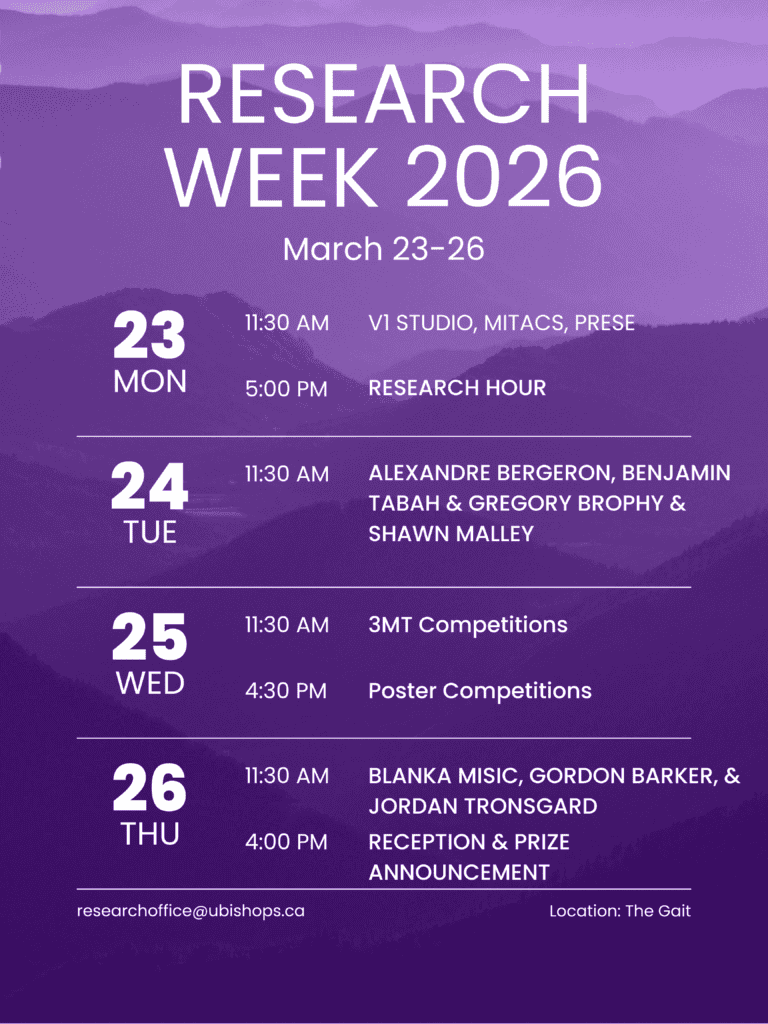
Monday, March 23: 11:30 – 1:00 PM
Alice Vervaeke
Title: V1 Studio and the QcSE program: Curious about how your research could help solve real-world problems?
V1 Studio is a non-profit organization dedicated to helping graduate students and researchers, in STEM and the social sciences, explore entrepreneurship. You’ll learn about their hands-on programs that guide you through idea exploration, skill building, and creating tangible impact from your research. Be inspired by real stories of researchers who brought their work beyond academia!
PRESE Recherche with Alexandre Nana
Title: Volet Recherche
The Pôle régional en enseignement supérieur de l’Estrie (PRESE), supported by Quebec’s Ministry of Higher Education, brings together the six higher education institutions in Estrie. Its mission is to intensify college-university collaboration, strengthen access to postsecondary studies, and support innovation throughout the Estrie region. PRESE is currently rolling out a research component, a natural extension of its mandate considering the dual mission of its member institutions. This initiative formalizes a dynamic already at work within PRESE projects, several of which are based on applied research approaches.Through this development, PRESE reaffirms its role as a forum for consultation and innovation in the service of student success. This new component will enable the creation a common networking space for researchers, faculty members, professionals, and partners to jointly design and carry out projects closely aligned with the region’s needs. It encourages inter-institutional research projects and promotes knowledge production and transfer to maximize benefits for the Estrie community and, more broadly, for Quebec as a whole.
Monday, March 23: 5:00 – 8:00 PM
Impact workshop with Alice Vervaeke
Title: Demystify entrepreneurship: explore your research impact beyond academia
Curious about how your research could have an impact outside of university? This interactive workshop gives you a space to reflect, share, and uncover the real-world impact of your work. Through lively discussions, inspiring stories from researchers who have become entrepreneurs, and a hands-on practical tool, we’ll break down the journey from research to entrepreneurship. By the end, you’ll gain a clearer sense of how your ideas can spark innovation and create tangible value in society.
Tuesday, March 24: 11:30 – 1:00 PM
Alexandre P. Bergeron, M.A. Student
Title: Ending Explained – Pursuing artistic practice as interdisciplinary research through genre-driven filmmaking and the power of storytelling traditions.
He will seek to outline his progress as he currently undertakes an Individualized Master’s in Film and Media Studies, the first of its kind pursued at Bishop’s. This interdisciplinary creative thesis project will ultimately culminate in the shooting of a genre-driven fictional short film that exists as an exploration folklore and storytelling traditions, as refracted through Bergeron’s recent personal experiences with grief and mourning. The project additionally seeks to refocus Bergeron’s filmmaking career thus far into a more research-based scholarly mode, implementing aspects of his recent experience in academic video essay innovation, while also continuing his ongoing pursuits in micro-budget filmmaking: studying and expanding upon the economics of small-scale independent film in the contemporary media landscape through more community-based practices and alternative funding sources.
Benjamin Tabah, M.A.
Title: The Final Act: Navigating Death, Ritual, and Caregiving through Playwriting
He will share how his individualized master’s project — the first MA in Humanities at Bishop’s — grew out of personal experiences with loss, caregiving, and the presence (or absence) of ritual in the face of death. Using the development of his play as a framework, he explores the interconnected themes of Medical Assistance in Dying (MAiD), ritual in a secular society, and the pressures placed on primary caregivers (especially women) in the sandwich generation. Working through a Practice as Research (PaR) approach, he will discuss what emerged through workshops, revisions, and audience feedback, and how the creative process helped him examine how families navigate caregiving and death without traditional structures to guide them.
Dr. Shawn Malley & Dr. Gregory Brophy
Title: Adaptive Forms: videographic criticism in new research and pedagogy
They will present their recently published multimedia book, Adaptive Forms (Lever Press, 2025). Focusing on contemporary science fiction film, this analysis considers affinities between the genre’s expansive concerns with technological and social adaption, and cinema’s own evolutionary responses to technological and aesthetic change. This videographic book (the second of its kind to be published) mixes traditional written scholarship with a range of videographic styles—including documentary filmmaking, music videos, supercuts, and slash fanvids—to illuminate the formal techniques through which cinema engenders techno-cultural adaptation. The arguments developed within entangle biological, semiotic, and cultural understandings of “adaptation,” gesturing to a post-human and post-cinematic future. As this project originated in the authors’ own pedagogical adaptation in the wake of the COVID-19 pandemic, we reflect on classroom use of this form in teaching and evaluation, including some of the student works that have been incorporated into the book project.
Thursday, March 26: 11:30 – 1:00 PM
Dr. Blanka Misic
Title: Remembering Ritual Experiences in the Cult of Mithras
How did people in the ancient world learn and remember religious rituals? How did their sensory environments shape their ritual experiences? In order to answer these questions this talk examines the archaeological evidence for one of the most popular gods in the Roman Empire: Mithras. The worship of Mithras rose in popularity from the first to the fourth century C.E. It is often described by scholars as a ‘mystery’ religion, featuring small groups of all-male worshippers who performed rituals in secret. This talk will explore how these elements facilitated social bonding between worshippers, leading to effective learning and transmission of ritual knowledge.
Dr. Gordon S. Barker
Title: Black Women Freedom Fighters: Revising America’s Emancipation Narrative
Drawing on the research for Black Women Freedom Fighters: Profiles in the Struggle Against Slavery, I will position female fugitive slaves and Black women kidnapping victims alongside the pantheon of antislavery leaders usually credited with ending American slavery. Focusing on several remarkable Black women, I will argue that they merit credit for advancing the antislavery agenda and contributing to freeing some four million of their brothers and sisters trapped in American slavery. I will discuss how their agency, militant resistance, and love of liberty touched and inspired many, energized antislavery advocacy networks, led to court action, expanded the Underground Railroad, and fueled transnational antislavery activity as it also transformed 19th-century notions of personal morality, religiosity, and humanitarianism. I will present a gendered bottom-up history celebrating the impact of truly extraordinary, ordinary Black women.
Dr. Jordan Tronsgard
Title: Why Are Comics So Good At Confronting The Bad?
He will present his edited volume Comics and Catharsis: Exploring Graphic Narratives of Trauma and Healing, published in Fall 2025 by the University Press of Mississippi. The primary question addressed by this volume is how comics engage with the processing of trauma through both their depictions and their reception. Specifically, it asks: what role does catharsis play in the writing, illustrating, and reader response to trauma in comics? Like trauma, catharsis is also a word of Greek origin, meaning purification or cleansing. Together, these concepts suggest that a wound left untreated may fester, while one that has been cleansed can begin to heal. While trauma is universal in the sense that experiencing pain—physical, psychological, or emotional—is not unique to any one group, its manifestations and the narratives crafted around it are deeply individual and often shaped by cultural context. At the same time, although comics and trauma are vast and diverse fields, many voices remain marginalized or silenced within both comics studies and trauma studies. Alongside the research questions outlined above, one of the objectives of this collection is to address this imbalance by presenting chapters on trauma from different cultural and linguistic perspectives, and by examining works beyond the limited canon that often dominates comics scholarship. In addition to discussing the volume itself, he will also speak about the genesis of the project and the future directions of his work in the field.
Full Schedule: