
Art History
Why Study Art History?
Using diverse approaches and theories, art is critically analysed in the larger social, cultural, economic, institutional, and ideological context of its production, display, and reception. As students engage with works of art and key texts in art history, theory, criticism, they develop visual as well as verbal and written literacy. Art History fosters creative and critical thinking, inquiry, analysis, and effective communication skills.

Career Possibilities
Art History students have gone on to graduate programs in art history, museum studies, architecture, art conservation and restoration, and arts administration. Some now work in art galleries and auction houses, others as art appraisers, freelance art critics/writers, independent curators, and university teachers.
Want to set academic goals?

Scholarships, Awards and Bursaries
Through the help of government, alumni, current students, faculty and staff, the Bishop’s Foundation, corporations and private donors, over 53% of our students receive financial assistance through scholarships, awards, grants, bursaries and loans. Just because you aren’t top of your class, or super involved outside the classroom, or can’t run the fastest doesn’t mean you won’t be eligible. We have hundreds of scholarships and awards that have a wide variety of requirements…you never know what you might receive!
Courses & Programs
Who is this program for?
While our program is primarily designed to meet the needs of Fine Arts students in Art History and Studio, we welcome students from all disciplines to the many courses that do not have prerequisites. Some of these courses are particularly appealing to students in Cultural Studies and New Media, Popular Culture, Religion, and Public History.
Students enrolled in the Honours Art History and Theory program must successfully complete 60 credits comprising 42 credits (14 courses) in art history or FIN cross-listed and cognate courses, and 18 credits (6 courses) in studio courses (FIS and FIN). Students can apply to the Honours Program anytime after the completion of 15 credits in art history courses.
Students enrolled in the Major in Fine Arts with a Concentration in Art History and Theory must successfully complete 48 credits comprising at least 27 credits (9 courses) in art history courses (FIH), 15 credits (5 courses) in FIS and FIN studio courses, and 6 credits to be selected from FIH courses, FIN cross-listed and cognates courses in consultation with the Art History and Theory program chair.
In its cross-disciplinary reach, Art History is a unique and wide-ranging discipline that encompasses aspects of history, philosophy, religion, psychology, sociology, gender studies, and cultural studies. Cross-listed courses with the departments of Classical Studies, Sociology, and History are offered to broaden the students’ conceptual horizons.
The Art History and Theory Minor is for students in any discipline who, in addition to their major concentration, wish to develop a secondary area of expertise in art history. The Minor allows students to sample from the courses offered through the Art History Program: introductory, period-based, thematic, and advanced courses. Students must complete any 24 credits (8 courses) of their choice in Art History (FIH) or cross-listed coursed (FIN 235, FIN 292 and FIN 388), including a minimum of 6 credits at the 300 level.
Through the methods and concepts of art history, students learn the ‘visual’ language of images as they acquire knowledge and understanding of all forms of visual arts ranging from earliest cave paintings to latest new media installations, from monumental to miniature.
Using diverse approaches and theories, art is critically analyzed in the larger social, cultural, economic, institutional, and ideological contexts of its production, display, and reception. As students engage with works of art and key texts in art history, theory and criticism, they develop visual as well as verbal and written literacy. Art History fosters creative and critical thinking, inquiry, analysis, and effective communication skills.
Resources
Foreman Art Gallery
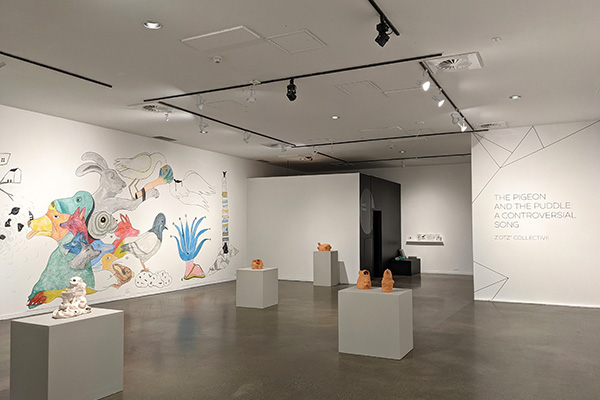
A major resource for Bishop’s students, as well as for the larger community, is the Foreman Art Gallery, located adjacent to the Centennial Theatre. The Gallery mounts exhibitions of art historical interest and shows representative of new directions in contemporary art. The Foreman Art Gallery also provides paid internships for students throughout the academic year and in the summer as well.

Library Learning Commons
The Library Learning Commons at Bishop’s University is designed to explore the rich intersections between learning, space, and technology.

About your professors
Our professors have a broad range of teaching and research interests and experience. Dr. Lacroix’s research examine how diverse representations of the human body in the visual arts cross borders between a real and an imaginary identity. Dr. Hart researches how public art, sculpture and monuments inform and perform cultural memory and identity. Intrigued?