
Physics and Astronomy
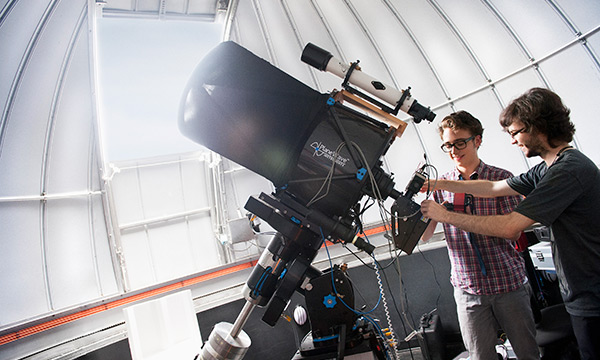
Undergraduate Degree Programs
The BSc Honours program prepares students for direct entry into graduate work in physics (leading to an MSc or PhD degree). The BSc Major program prepares students for industry, education and, on completion of a qualifying year, graduate work in physics. The Major program has sufficient electives to allow a substantial number of courses to be taken in another discipline (minor program), or even a second Major program in a related discipline.
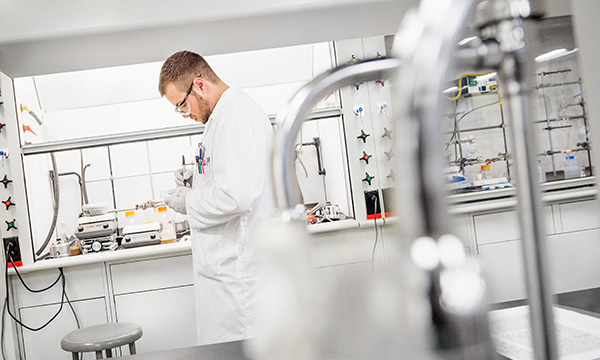
Master of Science in Physics
The Master of Science (MSc) program is designed to give students a much deeper appreciation of physics while at the same time training them to become independent researchers and scientists. Graduate supervision is available in a wide variety of disciplines including astronomy, astrophysics, exoplanetary science, theoretical cosmology and gravitational theory, and particle physics.
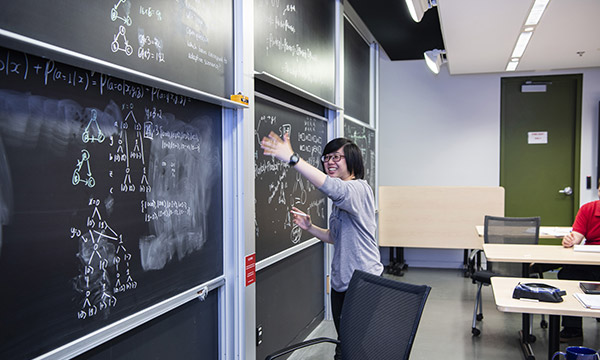
Perimeter Institute PSI START Satellite Program
The Perimeter Institute (PI) is a world-leading research centre in theoretical physics. PSI START Satellite at Bishop’s, funded by Perimeter, is a satellite program of the Perimeter Scholars International (PSI) START program for undergraduates. It runs in-person over a 2-week period and it includes courses, tutorials, and problem-solving sessions.
Courses & Programs
Physics is often regarded as the cornerstone of the Natural Sciences. It encompasses a diverse range of disciplines including astronomy and astrophysics, photonics, electronics, classical and quantum mechanics, statistical mechanics, particle physics, and solid state physics. The BSc Major program provides students with a fundamental understanding of physics. The highest level of specialization at the undergraduate level is the BSc Honours program. It prepares students for direct entry into graduate work in physics (leading to an MSc or PhD degree). Students may be admitted into the Honours program after one year is completed in the Physics Major program.
Physics Honours (120 credits)
Entrance Requirements for Honours Program: A student will normally be admitted to the Honours program after obtaining at least a 70% average on all required second-year (200-level) physics and mathematics courses. In order to complete an Honours degree, a student must normally obtain an average of at least 65% in required physics courses in each academic year.
Physics Major (120 credits)
A Physics Major is less intensive than the Honours program and does not require any 400-level physics courses or MAT 317.
Physics Minor (24 credits)
A minor in Physics allows students to gain a solid introduction to the subject.
The Master’s Program is designed to give students a deeper appreciation of physics while giving them a comprehensive exposure to research methodology that will allow them to become independent researchers. Research is being carried out in the following areas:
- Astrophysics (High Energy Phenomena, Stellar and Binary Evolution, Pulsars)
- Solid State Physics (Condensed Matter Physics, Many-Body Theory, Highly Correlated Systems)
- Theoretical Physics (Cosmology, Gravitational Theory, Dark Energy)
- Particle Physics (Lattice Quantum Chromodynamics)
PHY111 The Physics of Everyday Phenomena
PHY112 Introduction to Holography
PHY113 Introduction to Astronomy
Resources
The physics department has some excellent laboratory facilities. Interested in astronomy? We have state-of-the art instruments and telescopes.

Careers & Graduates
It turns out that physics graduates are highly sought after employees. A physics education emphasizes problem solving skills and abstract thinking. It is this training that makes physics graduates highly desired personnel in the job market. Our graduates are pursuing careers in pure research, industrial applications, education, space technology, finance, and technical writing. These foundational skills as well as training in practical subjects such as electronics, optics, lasers, numerical (computer) analysis also make them very desirable employees in the high-tech sector.

Scholarships, Awards and Bursaries
Through the help of government, alumni, current students, faculty and staff, the Bishop’s Foundation, corporations and private donors, over 53% of our students receive financial assistance through scholarships, awards, grants, bursaries and loans. Just because you aren’t top of your class, or super involved outside the classroom, or can’t run the fastest doesn’t mean you won’t be eligible. We have hundreds of scholarships and awards that have a wide variety of requirements…you never know what you might receive!
About your professors
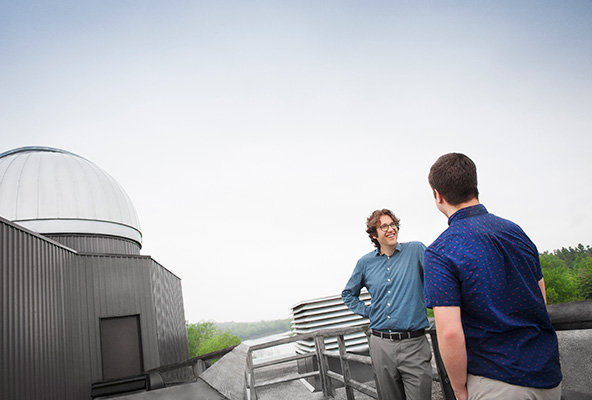
Dr. Ruan is a multi-wavelength observational astrophysicist, and his research group is focused primarily on combining the ‘cosmic messengers’ of gravitational wave (ripples in space-time detected by laser interferometers) and electromagnetic emission (light detected by telescopes) to study kilonova astrophysics, r-process nucleosynthesis, black hole accretion, and cosmology. Dr. Ruan is now a Canada Research Chair in Multi-Messenger Astrophysics.
Dr. Rowe is now a Canada Research Chair in Exoplanet Astrophysics. After his PhD, Dr. Rowe joined the Kepler team as a NASA Postdoctoral Fellow contributing towards the first Kepler discoveries and was awarded the NASA Exceptional Scientific Achievement medal for his work on measuring fundamental parameters of exoplanets. Intrigued?