
Central to the Sustainable Agriculture and Food Systems (SAFS) program (established in 2019), the 140-acre Educational Farm is a place to practice experiential learning by exploring, experimenting and modeling what future sustainable agroecosystems could look like.
The farm serves as a laboratory for field teaching, experiential learning, and exploration. Most of the SAFS courses include field components at the farm, as well as required practica.
The goal is to train a new generation of students in ecological agriculture, permaculture design, market gardening, organic fruit production, animal husbandry and agroforestry, while nurturing a transdisciplinary, systems-thinking perspective.
The farm provides students with a diversity of learning experiences in a multitude of traditional and innovative growing systems and integrated approaches. Join us to be a part of this evolving and thriving land, enriched by exciting research projects advancing sustainability in agriculture.
Current Research on the Educational Farm
The Educational Farm provides space for exploring and experimenting with solutions to agricultural and food systems challenges.
It serves as a platform for participatory research, in order to improve organic crop varieties and ecological farming techniques for cold-climate growing conditions.
From strawberry mulch, seed saving and soil conversation, to orchard trees, raspberry production and potato breeding, the faculty at Bishop’s are blazing trails in their “fields”.
Vision for the Educational Farm at Bishop’s
The Educational Farm is a living land laboratory whose purpose is to instill a passion for learning, drive agroecological science forward, and foster transformational change towards resilience and sustainability in our food system.
The vision will be achieved through education, research and community outreach.
Phase 1 of the Educational Farm (In Progress)
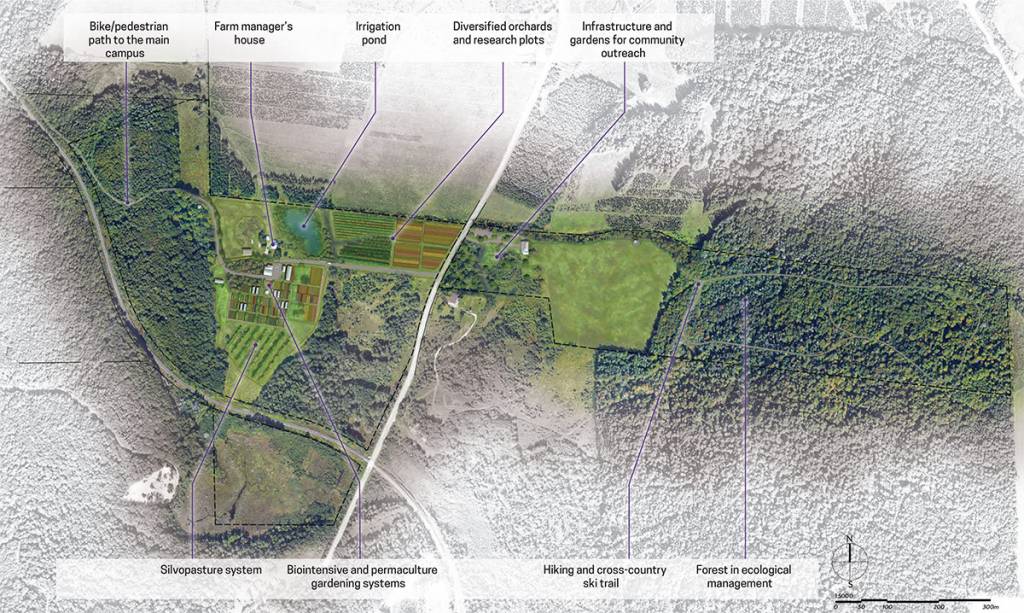
- Irrigation pond
- Hiking and cross-country ski trail
- Forest in ecological management
- Biointensive and permaculture gardening systems
- Greenhouse
Phase 2 of the Educational Farm
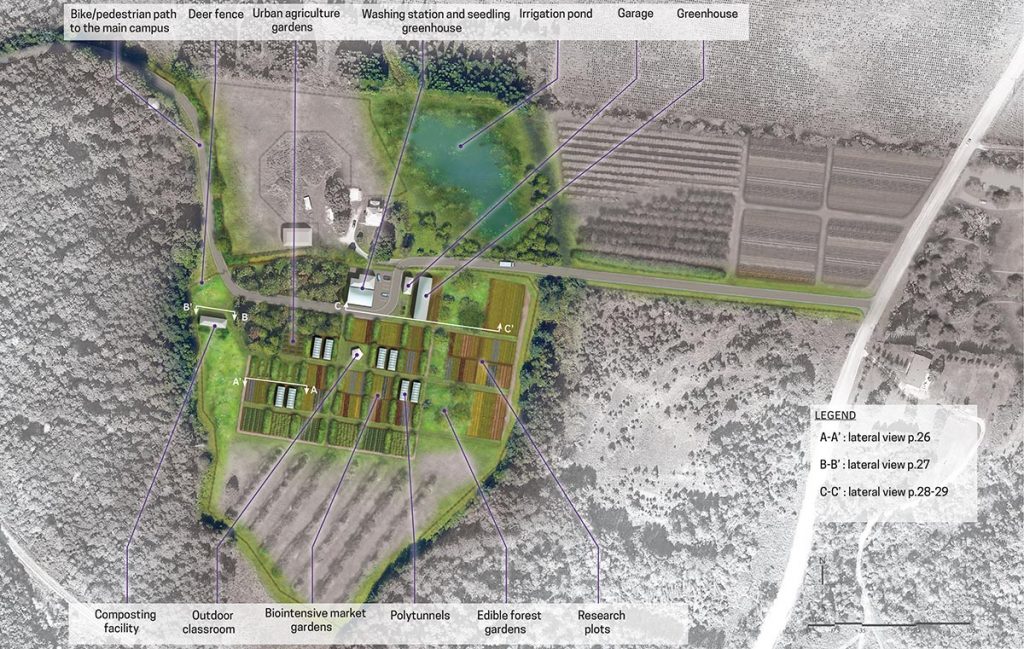
- Silvopasture system
- Infrastructure and gardens for community outreach
- Diversified orchards and research plots
- Edible forest gardens
- Outdoor classroom
- Biointensive market
- Polytunnels gardens
- Deer fence
- Urban agriculture gardens
- Washing station and seedling greenhouse
- Research plots
- Garage
Educational Farm Values
Agroecology and regenerative agriculture
The farm focuses on building and maintaining living soil, sequestering carbon, utilizing preventative pest and weed management strategies, and fostering the health and resilience of the entire agroecosystem.
Permaculture design principles
Students will learn how to design food production spaces (e.g. farms, urban lots, schoolyards, hospital grounds, municipal parks, etc.) that mimic the patterns and relationships found in nature, and which are deeply rooted in the place in which they occur.
Organic growing practices
We commit to avoiding the use of synthetic herbicides, pesticides, and fertilizers. We recognize that healthy soil, integrated weed and pest management techniques, observation, and preventative measures are critical to maintaining efficient production and high yields.
Biodiversity
This includes organisms both within and surrounding agricultural activities. Rather than focusing on specialized production, we promote polycultures, crop rotations, and diversified production with integrated systems. We commit to supporting pollinators and other wildlife with conservation of natural areas, pollinator gardens, and maintaining native perennials throughout the landscape.
The “closed-loop” approach
The farm will strive for self-sufficiency and minimal reliance on external inputs. We aim to produce resource needs internally and eliminate waste. For example, we plan to utilize food scraps from the Bishop’s cafeteria to create our own compost, to incorporate animal manure for soil fertility, and to grow diverse and nutrient-dense pastures to avoid or reduce the need for purchased animal feed and supplements.
Human-scale approach
The farm will consist of intensive plantings on only a few acres, avoiding vast fields of monocultures. Students will work with wheelbarrows, hand-operated tools and small two-wheeled walking tractors.
Appropriate technologies
We value technologies that facilitate sustainable agriculture and reduce the farm’s ecological footprint. For example, we plan to use geothermally heated greenhouses, solar-powered lightweight electric net fencing, drone-driven remote sensing of soil and plant conditions, etc.

Visit with SAFS
If you are curious about whether the SAFS program is for you and want to know more, speak with one of our recruitment officers. Email us at recruitment@ubishops.ca, or call us at 819-822-9600 ext. 2681.
If you are thinking of coming to Bishop’s, and would like to visit the farm, one of our team would be happy to accompany you! Please take a moment to book a campus tour.
We hope to see you soon!